

Nature, Circularity, and Time
An informal exploration into the concept of circularity, an idea largely shunned by Western thought. Through it, there contains the hope that it can be perceived.

This article hopes to both expatiate and elucidate a framework of idealist thought—one that relies upon circularity as its central reasoning model. Unlike the causality of traditional philosophical reasoning, circularity follows a different trail of time and thinking—one that allows philosophy to reflect upon ideas outside the realm of linear thought. In many ways this linear reasoning can be interpreted as a slice of a larger circular path of thought; expanding our view of the hike ahead may give us meaningful insights into the greater space in which ideals exist. Such a space begets a reevaluation of what it means for time to pass, including what it means for an event to cause another. Additionally, as we explore this circular geometry we can start to unravel how circularity, and reasoning, relates towards time itself.
Readers of this publication will know I have used the term cybernetics in the past to refer to the idea of circular reasoning. Going forward I have chosen to move away from the term, preferring the simple term circularity. The reasoning of this decision is twofold: Firstly, cybernetics as it exists is fundamentally a system of control, not thinking; Secondly, the more general term of circularity extends beyond the scope of the term cybernetics, giving breathe and a space to tackle fundamental concepts of circularity that are outside the realm of science. The modern world is a testament to the damage control–based systems thinking can cause: Advertising, rewards systems, algorithmic pricing, AI, the list could go on forever. Such a method of thinking is antithetical to meaningful philosophical inquiry; as such, this article’s inquiry into circularity hopes to create a new methodology that relies upon reflection and reason over control.
Natural Circularity
To begin our inquiry into circularity, the obvious space to begin in is the natural world: The real that we can see, hear, and engage with directly. These phenomenons, throughout the existence of the Earth and the Universe, come in cycles of differing scales and complexities: The seasons of our planet, to the cycles of star formation and death. Many of these cycles are described through linear systems—primarily to allow scientific thought to establish cause and effect, requiring a single point on the cycle to be the focus—but their cyclical nature nonetheless is forced to be recognized. This relationship between linear and circular thinking is present throughout our understanding of the natural world; many of these simple causes and effects become clouded in recursion and reflection as the scope of the inquiry expands.
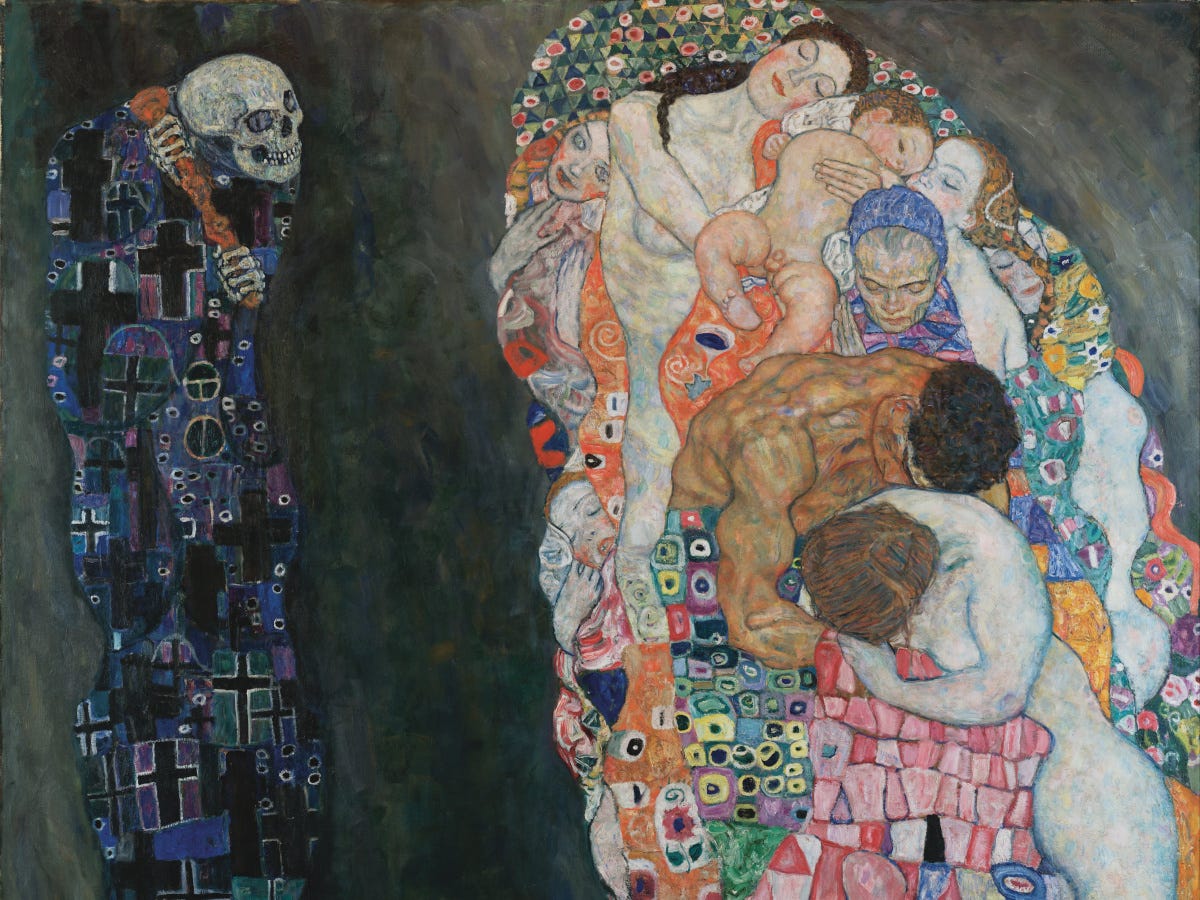

The lowest band of circularity within nature that will be talked about here, the pathway of life, one that ends in the death of the physical, natural form, is a pathway frequently viewed as a linear causality. Even though bends and turns may exist in our subjective experiential frameworks, it never curls back in on itself. But despite this, life and death itself merely form a short causeway in the circular nature of life itself. The death of something begets life again, either up or down the food chain, but that chain itself is circular: The animals at the top—apex predators, humanity, et cetera—die to enable the life of decomposers. These decomposers then reconstitute our former matter for the life at the bottom rungs of the chain to flourish once again. While our path through this cycle feels singular, linear, the truth is that all positions of this cycle are active, flaring, at all times. Our perspective, our fragment of consciousness stuffed within a sensory experiential complex, is merely at one part of this overall cycle.
The next band is that which exerts a great pressure upon the circularity of life: The climate, seasons, and the trends of Earth’s weathers. All should be familiar with the seasons, with a possible reproach towards one or the other. The circularity of the seasons are clear in their own exhibition, the continual shift of weather throughout our abstract, invented years. But it should be said how the seasons pressure the circle of life towards one end or another: The autumn and winter times of death, especially for smaller animals and plant life, with the spring and summer becoming great moments of bounty. The seasons portend the stresses placed upon the natural world, a stress that is exacerbated by the ecosystem and latitudinal band in which that nature resides. Just like all circularities we will discuss here, current scientific thought requires the decomposition of them into logically linear sequences of events. But what we see in the natural world itself is a collection of events all happening at once, a beautiful symphony of circularity.
At the final stop of this stretch of the journey, we come to the orbits of the universe and the stars. From the planets orbit around their respective stars, to the way stars themselves orbit galactic centers, to the methods in which stars come to be born and die. In many ways, this layer of circularity come to meet the lower rung of life and death: Stars form and are born in great gravitational formations, and come to die in great flashes of brilliance. There is one important difference, however, which is the limits of energy into the circularities of this scale. This is where the edges of nature’s supposedly closed systems comes to be found; the entropy of the universe increasing as many of these circularities come to be dissolved into lower states of energy. While the system of entropy appears closed, the true nature of the ultimate movement of the natural world extends beyond the current reaches of knowledge.
Artificial Circularity
Moving into the human world, circularity still espouses itself still to all who would listen. Be it routines in an individuals daily life, to the cycles of fashion and fads, and finally to the birth and death and civilizations themselves, circularity illuminates the spirit of human endeavor throughout all that it has accomplished. Despite the modern economic arguments of infinite growth, the truth remains that circularity is the natural state of the human gestalt, that for all human invention comes a contraction of the human well-being; that for all the benefits industrialized society offers, it turns humanity deeper towards its animalistic natures. Just as reason came to cannibalize itself into subjectivity and instrumentation, so too does the ever greater technological world descend itself into a farce of false competition, spurs of violent outbursts, and a greater tendency towards self-destruction. Just as all circularities exist at all points within itself, the contemporary human world expands its own cycles into its greatest enlightenment and perversion simultaneously.
At the smallest scale of such chained rings begins the humble human, of whom comes to be dominated by their own personal cycles. Historically these cycles may have existed to enlighten, to provide meaning innately, to be objective to their own existence. Modernity has moved such cycles into the realm of instrumentation, a world of means to approach ends of self-interest. Daily habits, ritualized breaks from circularity that constitute an intersection between the frequent and the infrequent, a larger cycle of behavior that intersperses the illusion of free association with the world. Humanity is a race of rituals, a species of specificity, and it should be no surprise that such rituals beget our own individual cycles. Especially in the face of modern repression, the domination of supposed reason over the once sanctified individual, it should be of little surprise to watch as humanity comes to combat the hypostatized rule based order with their own combative circular rituals.
These rituals expand into larger social circularities: The fad, the popular fronts, and the push and pull of economic forces. In this context the infinite growth theory becomes a mere positive feedback into an artificial control system, a cybernetic circularity, that one can only conclude has become cancerous. Fads accelerate, mimetic behaviors strengthen as humanity must contend with an ever complicating world, where imitation becomes superior to reasoned thought, and the economy hurdles towards its own depressions. It is impossible not to focus on the particulars of the modern social circularity, the perpetually metastasized beliefs that rest upon modern subjective irrationality. The world becomes a model of self-interest, a world where instrumental reason, reflecting back upon that self-interest, comes to be itself monitored and controlled under ever widening fields of subjectivity. Through these processes comes the ever accelerating forces of progress, technology, and the inevitable depressions that follow such naïve, shortsighted subjective instrumentation.
The astonishing speed in which society is hurdling itself comes towards the greatest circularity within the natural human world: civilizations themselves. The current civilizations of humanity was birthed out of an apotheosis of reason, a belief that our own beliefs and philosophical thought was rooted in objective truth. The founding fathers in their proclamation of life, liberty, and the pursuit of happiness, believed such rights were true in and of themselves, that they were the ends to be attained. While one can debate and argue historical actions and the means in which the following civilization acted upon, the bedrock itself was as solid as the religious proclamations that preceded them. Civilizations, anthropologically born out of benefits of cooperation, are beings birthed by objective truth, by the belief that this coming together of humanity holds principle meaning towards an objective end. However, inevitably, as that objectivity splinters and subjective beliefs come to rule, that same bedrock cracks. While subjectivity will reinforce the foundations as long as it can, inevitably the structure of the civilization itself collapses. But just as all circularities follow unto themselves, civilizations will reform in the ruins of the old.
A Superposition of Truth
It is best noticed how, despite the truths seen in the circular nature of these interconnected parts of the natural and artificial worlds, they are never identical. In fact, the singularly defined circularities—of civilization, seasons, and all others—are themselves not immutable. This is where the natural circularities differ from that of transcendental ideals: They are mutable, affected structures, that are themselves never singularly true. Instead, they exist as a superposition of truth, where a singular truth can be gleaned by reducing the circularity towards a singular point. Within the naturalist circularities espoused here, this reduction operation comes as an element of Time. The realm of the transcendental and its relationship to circularity, and Time, remains undefined in the scope of this article, as such concepts will be explored in a later text.
However, this brings forward an important distinction—between the natural and transcendental—as the natural exists in a state where circularities are perpetually reduced into singular points. This reduction is what allows the scientific methodology of the natural sciences to exist, and to hold a strong efficacy. Such an autonomous reduction of the superposition may not be found in the transcendental world. In fact, Time itself is a transcendental concept with effects within in the natural. But that does not make Time a frivolous, or otherwise passive force within the gestalt nature of circularity: These circularities are changed by time’s active observance of their infinite points along their nature. Time itself serves not as a hiker, walking along circular trails, but as a force of change itself. Just as humanity has become the anthropocene, a global natural force that changes the cycles of the Earth and below, Time itself is a transcendental force of change that acts across the circularities themselves.
What becomes an ideal, or other objective truth, within a system of ever reducing circularities as they are manipulated by Time? Perhaps they are first principles, hypostatized points within circularity that transcend the cycle itself, or perhaps they themselves are circularities which have reached homeostasis, holding against the changing force of Time. Regardless, natural circularity remains an ever present gestalt, above all the reduced systems and methodologies used to explain natural phenomenon, itself beneath the domineering boot of Time. To engage with such circularities meaningfully is a step towards rekindling a future understanding of the natural, the transcendental, and our relation to Truth beyond the mere instrumentalization of reason itself.